How to Build Topical Authority in 2026: Complete SEO Guide for Hyderabad Businesses
Publishing more articles does not automatically mean your website will rank higher on Google.
Many businesses invest in blogs, target popular keywords and publish content regularly, yet struggle to build consistent organic visibility.
One possible reason is that their content lacks a clear subject focus.
A website may publish articles about unrelated topics without establishing a useful, connected collection of information around the services it actually provides.
Understanding how to build topical authority can help businesses create a more structured approach to search engine optimization.
For businesses in LB Nagar, Dilsukhnagar, Gachibowli, Madhapur, Kukatpally, Hitech City and across Hyderabad, a strong content strategy should demonstrate genuine expertise in the subjects that matter to potential customers.
This guide explains topical authority, topic clusters, semantic SEO, internal linking, content planning and how to measure meaningful improvements in 2026.

What Is Topical Authority in SEO?
Topical authority is the degree to which a website is recognized as a useful and knowledgeable source about a particular subject.
In practical SEO, building topical authority involves publishing accurate, original and connected content that addresses important questions within a clearly defined subject area.
For example, a digital marketing agency specializing in SEO might create useful resources covering:
- Keyword research
- Technical SEO
- Local SEO
- Google Business Profile optimization
- Content strategy
- Website performance
- Search Console
- Organic lead generation
These subjects connect naturally to the agency’s expertise.
A website that explains them clearly can become more useful to customers researching SEO services.
Featured Snippet Answer: To build topical authority, choose a subject related to your expertise, research customer questions, create a comprehensive pillar page, publish useful supporting articles, connect relevant pages through internal links, demonstrate original experience and regularly update content based on search performance.
Why Does Topical Authority Matter in 2026?
Search engines aim to connect people with relevant and helpful information.
Publishing isolated articles without a clear content strategy can make it difficult to serve different stages of a customer’s research journey.
A structured topical strategy helps businesses:
- Organize website information logically
- Answer related customer questions
- Improve navigation between relevant pages
- Develop deeper subject coverage
- Identify content gaps
- Support commercial service pages
- Demonstrate genuine expertise
The purpose is not to create the largest possible number of pages.
It is to create the most useful collection of content for the audience the business serves.
Is Topical Authority a Direct Google Ranking Factor?
Google does not describe a universal numerical “topical authority score” that websites can optimize.
SEO professionals commonly use topical authority as a strategic concept rather than a single official ranking metric.
Google’s published guidance emphasizes helpful, reliable, people first content and making websites easy to crawl and understand.
Therefore, businesses should avoid treating topical authority as a guaranteed ranking formula.
Instead, focus on relevance, content quality, clear website structure and demonstrable expertise.
Review Google’s helpful content guidance for the underlying principles.
1. Identify Your Core Business Topics
Begin by identifying the subjects directly connected to your products, services and professional knowledge.
For a digital marketing company in Hyderabad, core topics might include:
- Search engine optimization
- Google Business Profile management
- Website development
- Content marketing
- Digital advertising
Each core topic can support several related subtopics.
Choose relevance over volume
A business should not target a topic merely because it has high search volume.
Ask whether the subject helps potential customers understand a problem that your company can genuinely solve.
This keeps content aligned with business objectives.
2. Understand Search Intent Before Writing
Search intent explains what a person wants to accomplish through a search.
Different queries require different types of content.
Informational searches
Example: What is technical SEO?
The user wants an explanation.
Comparison searches
Example: Local SEO versus Google Ads.
The user is comparing solutions.
Commercial searches
Example: SEO services in Hyderabad.
The user may be evaluating providers.
A useful topical strategy connects these different stages without forcing every article to become a sales page.
3. Build Topic Clusters Around Core Subjects
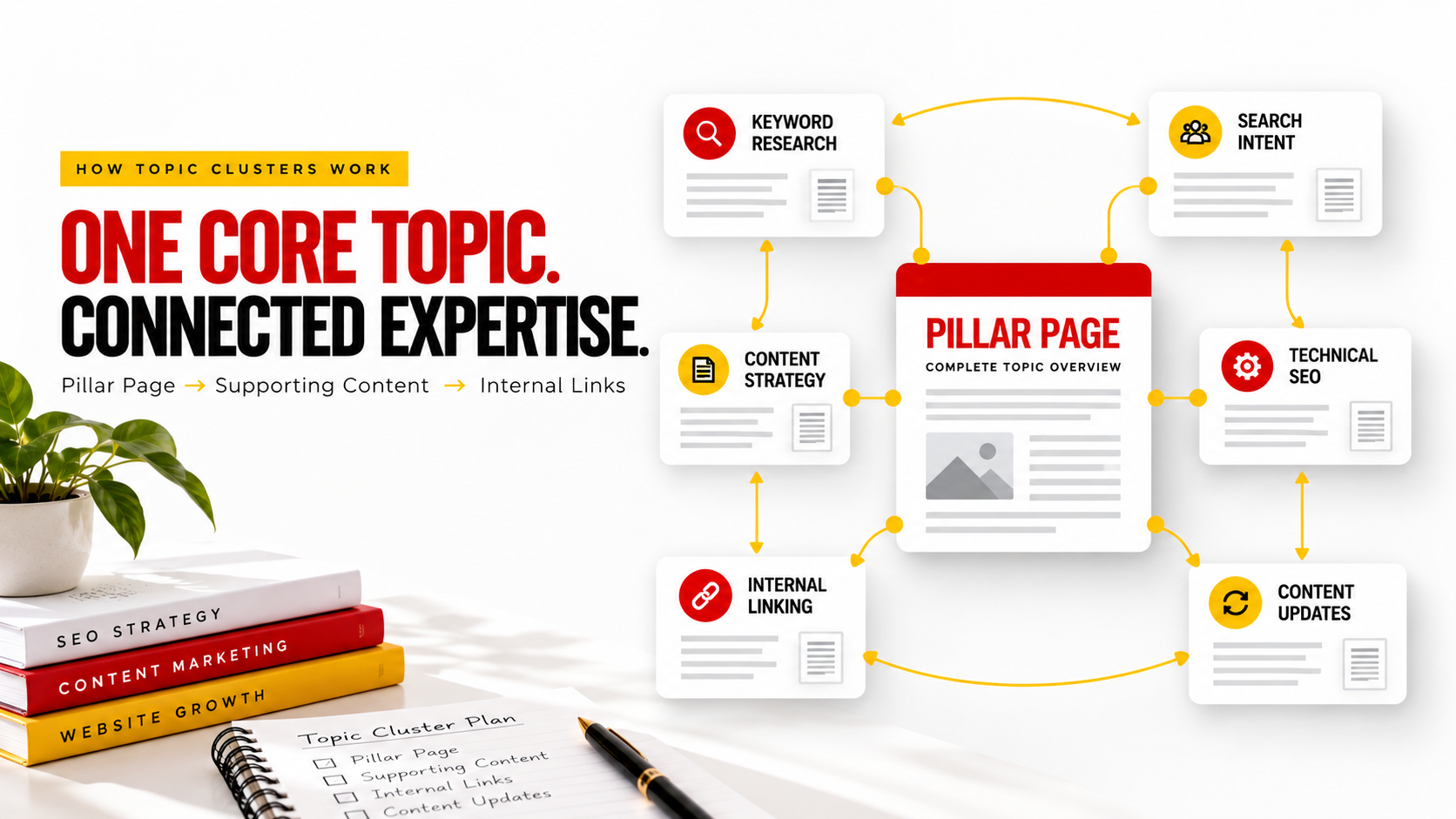
A topic cluster is a group of related pages organized around a central subject.
Typically, it contains one broad pillar page and several supporting pages that explore narrower questions.
Example: Local SEO topic cluster
Pillar topic: Local SEO for Businesses
Supporting subjects could include:
- Google Business Profile optimization
- Google Maps visibility
- Local keyword research
- Business reviews
- Local citations
- Service area optimization
- Local SEO measurement
Each article should answer a distinct question.
Relevant internal links help visitors move between the broader subject and supporting explanations.
4. Create Comprehensive Pillar Pages
A pillar page provides a broad introduction to an important topic.
It should help readers understand the subject and direct them to more detailed resources when necessary.
A strong pillar page usually includes:
- A clear definition
- Important concepts
- Practical explanations
- Relevant examples
- Common questions
- Links to supporting resources
- Appropriate next steps
For example, a comprehensive SEO services page can explain the agency’s approach to organic visibility and connect readers to educational resources.
Explore Digital Natives SEO Services for the broader service context.
5. Publish Supporting Articles With Distinct Purposes
Supporting articles should explore specific questions in greater depth.
A broad article about SEO might introduce technical optimization.
A supporting article could explain how to diagnose indexing problems or improve Core Web Vitals.
These articles should not simply repeat the pillar page.
Use a content brief
Before writing, define:
- Primary search intent
- Target audience
- Main question
- Important subtopics
- Relevant examples
- Potential internal links
- Desired customer action
This reduces duplication and helps every article serve a meaningful purpose.
6. Improve Semantic SEO Naturally
Semantic SEO focuses on the meaning and relationships behind search queries rather than repeating an exact keyword.
For example, an article about Google Business Profile optimization may naturally discuss business categories, services, verification, opening hours, reviews and local relevance.
These concepts belong together because they help explain the subject.
Use descriptive headings, precise terminology and clear examples.
Avoid adding unrelated phrases simply because an SEO tool suggests them.
Good semantic relevance comes from accurately covering the topic.
7. Build a Logical Internal Linking Structure
Internal links connect pages within the same website.
They help visitors discover related information and help search engines understand website structure.
Practical linking approach
- Link pillar pages to relevant supporting articles.
- Link supporting articles back to useful broader resources.
- Connect related supporting articles when appropriate.
- Use descriptive anchor text.
- Avoid excessive or irrelevant links.
For example, an article about local SEO can link to a relevant Google Business Profile service page when the reader may benefit from professional assistance.
Explore Google Business Profile Services for that service category.
Internal links should help readers, not exist merely to satisfy an arbitrary linking target.
8. Demonstrate Real Experience and Expertise
Original experience can make business content more valuable.
Useful evidence may include:
- Real project examples
- Original photographs
- Detailed processes
- Practical demonstrations
- Relevant professional knowledge
- Accurate sources
- Transparent author information
For a Hyderabad SEO agency, useful content might explain how to review a website’s Search Console performance or organize a local keyword research process.
Use genuine experience where available.
Do not invent client results, testimonials or professional qualifications.
9. Maintain Strong Technical SEO Foundations
Content quality is important, but search engines must also be able to discover and access important pages.
Review:
- Website crawlability
- Indexing controls
- Canonical URLs
- Internal links
- XML sitemaps
- Mobile usability
- Page performance
- Duplicate content
A poorly organized website can make even useful content difficult to discover.
Google’s SEO Starter Guide explains important website optimization fundamentals.
10. Update and Consolidate Existing Content
Building topical authority does not always require publishing new articles.
Existing content may already cover many relevant subjects.
Conduct a content audit to identify:
- Outdated information
- Duplicate articles
- Overlapping search intent
- Missing internal links
- Thin content
- Important unanswered questions
When two articles serve essentially the same purpose, consider whether updating and consolidating them would create a better resource.
Use appropriate redirects when removing or replacing existing URLs.
A smaller collection of stronger pages can be more useful than a large collection of repetitive articles.
11. Build Local Topical Relevance for Hyderabad
Businesses serving Hyderabad can connect their subject expertise with genuine local customer needs.
However, local relevance should not mean inserting locality names into every paragraph.
LB Nagar and Dilsukhnagar
Local service businesses may benefit from content explaining service availability, common customer questions and how enquiries are handled.
Gachibowli and Hitech City
Professional service companies can create detailed educational content, process explanations and relevant case studies for their intended customers.
Madhapur and Kukatpally
Businesses can develop useful service resources and demonstrate their expertise through genuine examples.
Only claim a physical location where the business actually operates.
Content should represent genuine service coverage across Hyderabad and Telangana.
12. How to Measure Topical Authority Progress
There is no single official Google metric that measures topical authority.
Instead, evaluate several useful indicators.
- Organic impressions for related queries
- Organic clicks to topic cluster pages
- Growth in relevant search queries
- Performance of supporting articles
- Indexing status
- Engagement with related content
- Qualified enquiries
- Conversions from organic traffic
Google Search Console can help identify how related pages perform in organic search.
Website analytics can provide additional insight into visitor actions.
Do not assume that an increase in article count proves an increase in authority.
A Practical 90 Day Topical Authority Plan
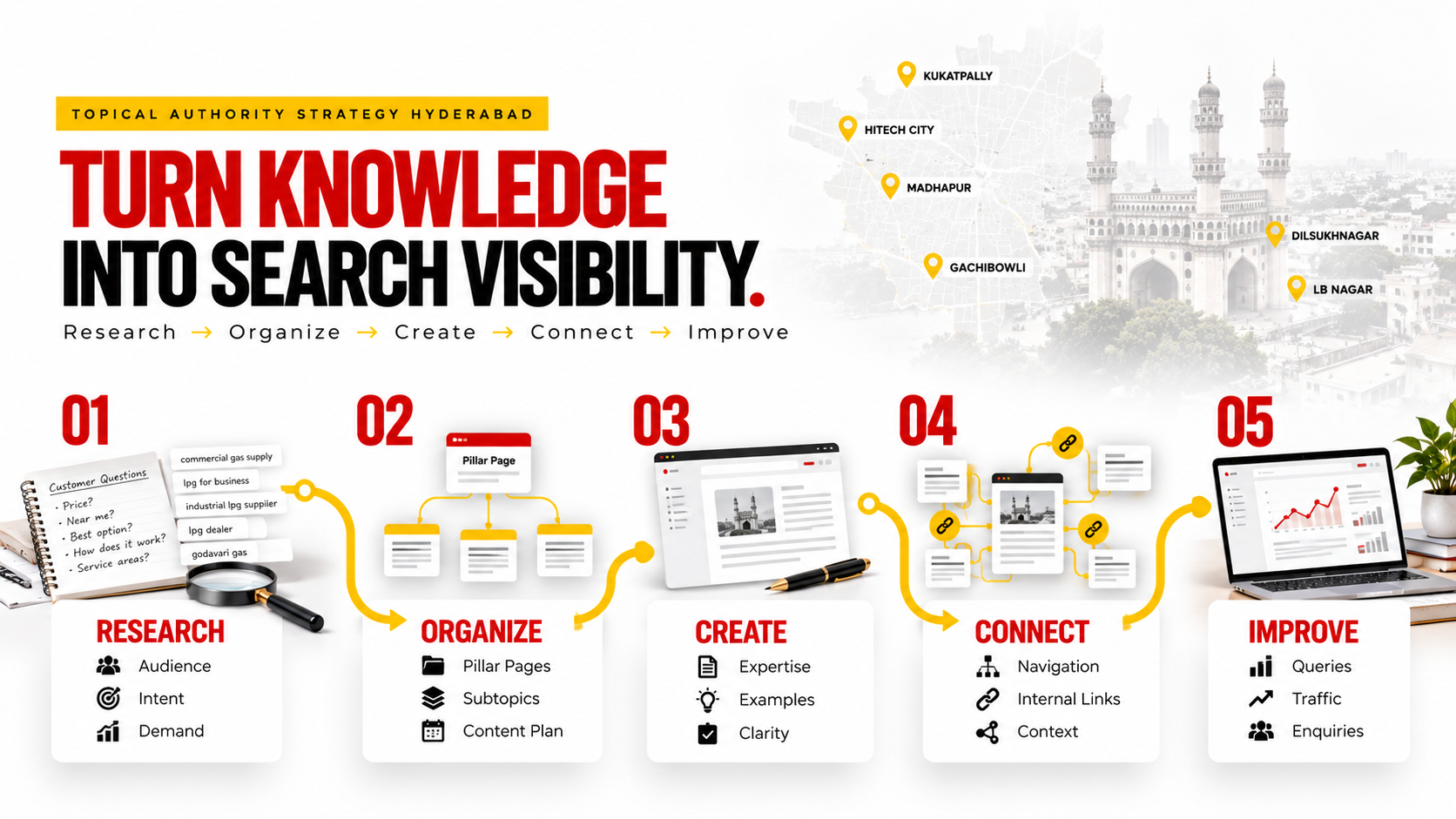
Days 1 to 30: Research and Audit
Identify the business’s core topics, review existing content and research relevant customer questions.
Group related searches by intent.
Choose one priority topic cluster based on genuine expertise and business relevance.
Days 31 to 60: Build the Content Foundation
Create or improve the central pillar page.
Publish useful supporting articles that address distinct questions.
Connect related pages through descriptive internal links.
Days 61 to 90: Improve and Measure
Review indexing, page performance and early search data.
Improve unclear sections, add relevant examples and address important content gaps.
Continue measuring qualified traffic and customer enquiries.
This schedule is a planning framework, not a promise of rankings within 90 days.
Common Topical Authority Mistakes
- Publishing unrelated articles
- Choosing topics only by search volume
- Creating multiple pages for the same search intent
- Using repetitive AI generated content without review
- Ignoring original expertise
- Publishing thin supporting articles
- Forgetting internal links
- Ignoring technical SEO
- Creating unnecessary location pages
- Failing to update outdated information
- Measuring only keyword rankings
- Expecting topical authority to guarantee Google rankings
Topical Authority SEO Checklist
- Identify core business subjects
- Understand the intended audience
- Research search intent
- Audit existing content
- Group related questions
- Plan useful topic clusters
- Create comprehensive pillar pages
- Publish distinct supporting articles
- Add relevant internal links
- Use descriptive headings
- Include original examples
- Reference authoritative sources
- Maintain technical SEO
- Review content duplication
- Update outdated articles
- Monitor Search Console
- Measure qualified enquiries
- Improve content based on evidence
Conclusion: Build Expertise Before Building More Pages
Understanding how to build topical authority helps businesses move beyond publishing disconnected articles.
A strong content strategy begins with genuine expertise, customer needs and clear subject organization.
Topic clusters help connect related information. Pillar pages introduce important subjects. Supporting articles answer detailed questions. Internal links make the content easier to explore.
For businesses in LB Nagar, Dilsukhnagar, Gachibowli, Madhapur, Kukatpally, Hitech City and across Hyderabad, this approach can support a more useful and coherent organic search presence.
The objective is not to publish the most content.
It is to become a genuinely useful resource for the subjects your business understands and the customers it serves.
Frequently Asked Questions
What is topical authority in SEO?
Topical authority describes how strongly a website demonstrates useful knowledge about a particular subject. Businesses can develop it through relevant content, clear topic organization, original expertise and helpful internal links.
How do you build topical authority?
Choose a subject related to your expertise, research customer questions, build topic clusters, create pillar pages, publish supporting articles, add internal links and regularly review content quality and performance.
How many articles are needed to build topical authority?
There is no fixed number of articles required. The appropriate amount depends on the topic, audience needs, existing content and the depth required to answer important questions usefully.
Is topical authority a direct Google ranking factor?
Google does not publish a universal numerical topical authority score. The term is commonly used in SEO strategy to describe useful subject coverage, expertise and content relationships rather than a single official ranking factor.
What is the difference between a pillar page and a topic cluster?
A pillar page provides a broad resource about a central subject. A topic cluster includes that central resource and related supporting pages that explore narrower questions, connected through relevant internal links.
Can AI generated articles help build topical authority?
AI can assist research and drafting, but published content should be accurate, original, useful and reviewed by someone with appropriate subject knowledge. Producing large volumes of repetitive content does not automatically establish authority.
How can Digital Natives help businesses build topical authority?
Digital Natives provides SEO, content strategy, website development and local search optimization services for businesses across Hyderabad and Telangana. Businesses can contact the team to discuss their content structure and organic visibility goals.
Build a Stronger SEO Content Strategy With Digital Natives
Publishing content is only one part of organic search growth. Your website also needs useful topic coverage, clear internal linking, technical accessibility and a strategy aligned with customer intent.
Digital Natives helps businesses across Hyderabad and Telangana develop structured SEO and content marketing strategies.
Company: Digital Natives
Location: LB Nagar, Hyderabad
Service Area: Hyderabad and Telangana
Phone:
+91 9052666707
Email:
info@digitalnatives.co.in