“`html
How to Improve Google Rankings: 12 Powerful Strategies for Hyderabad Businesses in 2026
Getting a website published is easy. Making it visible when potential customers search for your services is much more challenging. Business owners who want to understand how to improve Google rankings need a structured strategy that combines useful content, technical performance, search intent, website authority and local relevance.
Google does not rank websites based on one isolated factor. Its automated systems evaluate many signals to identify pages that are relevant, useful and trustworthy for a particular search. This means there is no single button, plugin or shortcut that can guarantee a first position.
For businesses in Hyderabad, stronger organic rankings can create opportunities to attract customers from LB Nagar, Dilsukhnagar, Gachibowli, Madhapur, Kukatpally, Hitech City and other areas without paying for every website visit.
This guide explains practical steps businesses can follow to improve search visibility, attract qualified organic traffic and build a sustainable ranking strategy in 2026.
How Can You Improve Google Rankings?
To improve Google rankings, create original content that accurately satisfies search intent, use descriptive page titles and headings, make important pages easy to crawl, strengthen internal links, improve mobile usability and Core Web Vitals, earn genuine authority and monitor performance through Google Search Console.
Local businesses should also maintain accurate contact information, create useful service pages, optimize their Google Business Profile and publish content relevant to the locations they genuinely serve.
The most effective approach is continuous improvement. Businesses should avoid shortcuts that create temporary visibility but weaken long term trust.
How Google Rankings Work in 2026
Google uses automated ranking systems to evaluate a large number of signals and present results that appear most relevant and useful for each search. The result shown to one person may differ from another because location, language, device, search wording and context can influence what Google displays.
A business searching from LB Nagar may see different local results from someone searching in Gachibowli or Kukatpally. This is especially common for service based and near me searches.
Google also uses information from page titles, headings, body content, links, images and other sources to understand what a page is about. Strong Organic SEO Hyderabad therefore requires consistency across the entire page rather than repeating one keyword many times.
Google does not accept payment to rank a normal organic page higher. Paid advertisements and organic rankings operate through different systems.
1. Understand Search Intent Before Creating Content
Search intent is the purpose behind a search. A page is unlikely to rank consistently when its content does not match what the user is trying to accomplish.
Informational intent
The searcher wants to learn something.
- How to improve Google rankings
- How long does SEO take?
- What is local SEO?
Commercial intent
The searcher is comparing services or providers.
- Best SEO agency in Hyderabad
- SEO services for small businesses
- Website development company Hyderabad
Transactional intent
The searcher may be ready to contact or purchase.
- Hire an SEO expert Hyderabad
- Request an SEO audit
- Local SEO company near me
Before creating a page, examine the customer problem, the type of answer required and the action the visitor may want to take next. A service page should not be written like a general educational article, and an informational guide should not read like an aggressive advertisement.
2. Create a Focused Keyword Strategy
A useful keyword strategy connects customer language with relevant website pages. It should not consist of adding hundreds of unrelated phrases to one article.
Begin with one clear topic and identify related search variations. For this article, the focus is how to improve Google rankings. Related terms include SEO Services Hyderabad, Google Ranking Strategy Hyderabad, Organic SEO Hyderabad and Local SEO Hyderabad.
Assign different keywords to the pages that best satisfy them. For example:
- An SEO service keyword should lead to an SEO service page
- A website development keyword should lead to a website service page
- A Google Business Profile keyword should lead to a relevant local SEO page
- An educational question should lead to a helpful blog article
This prevents multiple pages from competing for the same topic and makes the website easier for visitors and search engines to understand.
Use local keywords naturally
Location terms should appear only where they add meaning. A business serving Hyderabad may naturally discuss projects, services or customer needs in LB Nagar, Dilsukhnagar, Madhapur, Gachibowli, Kukatpally and Hitech City.
Avoid inserting every neighbourhood into every paragraph. This weakens readability and can make the content appear artificial.
3. Publish Helpful, Reliable and People First Content
Google recommends creating content primarily to help people rather than creating pages only to manipulate search rankings. A useful article should provide enough information for readers to understand the topic and take a sensible next step.
People first content should demonstrate:
- Clear knowledge of the subject
- Original explanations or practical insights
- Accurate and current information
- A well defined audience
- A useful purpose
- Transparent business or author information
For example, a blog about how to improve Google rankings should explain what businesses can realistically control, which actions require ongoing work and which promises should be treated with caution.
It should not guarantee a number one ranking, invent statistics or repeat generic advice without explaining implementation.
Review Google’s official people first content guidance when planning new articles.
Create content from genuine business experience
A company can strengthen content by including useful observations from audits, campaigns, customer questions and completed projects. This does not require exposing confidential information.
For example, an SEO agency may explain how unclear service pages, duplicate location content, weak internal links or poor mobile usability commonly affect local business websites.
Experience based content is often more useful than an article that simply rewrites information already available everywhere.
4. Improve On Page SEO Elements
On page SEO helps visitors and search engines understand the purpose of an individual page. Every important page should have a clear topic, descriptive title, useful headings and readable content.
Write a descriptive SEO title
The title should accurately represent the page and help searchers decide whether it matches their needs. Place the main topic near the beginning where possible, but keep the wording natural.
For example:
How to Improve Google Rankings: 12 Powerful Strategies for 2026
Avoid vague titles such as “Home,” “Services” or “Best Solutions.” Also avoid titles filled with repeated keywords and promotional claims.
Create a useful meta description
A meta description provides a concise summary of the page. Google may use it when creating the search result snippet, although it can also select relevant text from the page.
Write a distinct description that explains the benefit of the page and matches its content. Do not use the same description across every service and blog page.
Use headings to organize the answer
The H1 should describe the main topic. H2 and H3 headings should divide the article into logical sections that help readers scan the content.
Headings should describe what follows instead of being used only to insert keywords.
Optimize images accurately
Use descriptive filenames, relevant alt text and meaningful captions. Alt text should explain the image for users who cannot see it. Avoid filling alt text with repeated location and service terms.
5. Strengthen Internal Linking
Internal links connect related pages on the same website. They help visitors discover additional information and help Google find and understand important content.
For example, this article can direct readers to Digital Natives’ SEO Services because the service page is directly relevant to improving organic visibility.
Businesses needing a stronger technical foundation may also review Website Development Services in Hyderabad.
Follow these internal linking practices:
- Link to pages that genuinely help the reader
- Use descriptive anchor text
- Keep important pages accessible through navigation or contextual links
- Fix broken internal links
- Avoid linking every repeated keyword
- Do not overload paragraphs with unnecessary links
A well connected content structure can support topical authority because it shows how related services, guides and resources fit together.
6. Fix Technical SEO and Indexing Problems
A valuable page cannot rank if Google cannot reliably access, understand or index it. Technical SEO focuses on removing barriers that prevent search engines and users from using the website properly.
Check for:
- Pages blocked by robots.txt
- Important pages marked noindex
- Broken links and server errors
- Duplicate URLs
- Incorrect canonical tags
- Missing XML sitemaps
- Redirect chains
- Mobile rendering problems
- Important content hidden behind unsupported interactions
Google Search Console can help website owners inspect URLs, review indexing reports and identify problems affecting search visibility.
Submitting a sitemap can help Google discover important URLs more efficiently, but a sitemap does not guarantee that every page will be indexed or ranked.
Technical fixes should support useful content. A technically perfect page with weak or irrelevant information is unlikely to perform well simply because it has no errors.
7. Improve Page Experience and User Satisfaction
Google wants to recommend websites that provide useful information and a smooth browsing experience. Even when your content is informative, poor usability can reduce engagement and make it difficult for visitors to complete important actions.
Page experience includes loading speed, mobile usability, visual stability, navigation, readability, security, and overall user satisfaction. Improving these elements can support your efforts to improve Google rankings while also increasing enquiries, calls, purchases, and conversions.
Improve Website Loading Speed
Visitors expect pages to load quickly. A slow website can increase bounce rates and reduce the number of people who explore your services or contact your business.
Improve loading performance by compressing images, using modern image formats, reducing unnecessary scripts, enabling browser caching, choosing reliable hosting, and removing unused plugins.
Make Every Page Mobile Friendly
A large percentage of searches now happen on mobile devices. Your website should adapt correctly to different screen sizes without requiring users to zoom, scroll sideways, or struggle with small buttons.
Check that your text is readable, navigation is simple, contact buttons are easy to tap, forms are short, and important information appears clearly on smaller screens.
Improve Navigation and Readability
Visitors should be able to understand where they are, what the page offers, and what action they should take next.
Use descriptive menus, clear headings, short paragraphs, visible calls to action, useful internal links, and enough spacing between sections. Avoid overcrowded layouts, intrusive popups, and unnecessary animations that distract visitors from the main content.
Use Secure Website Connections
Your website should use HTTPS to protect information exchanged between the visitor and the website. Security is especially important for contact forms, payment pages, customer accounts, and ecommerce websites.
A secure website also builds trust because visitors can browse and submit information with greater confidence.
8. Build Topical Authority
Publishing one article about a topic is rarely enough to establish strong authority. Google needs to understand that your website consistently provides useful and complete information within your industry.
Topical authority is built when your website covers a subject in depth through connected pages, supporting articles, service content, examples, frequently asked questions, and expert insights.
For example, a digital marketing company should not publish only one general SEO article. It can create supporting content about keyword research, local SEO, technical SEO, Google Business Profile optimization, link building, website speed, content marketing, and SEO reporting.
Create Topic Clusters
A topic cluster normally includes one main pillar page and several supporting articles. The pillar page explains the broad topic, while supporting pages answer more specific questions.
All related pages should be connected through internal links. This structure helps visitors explore the subject and helps search engines understand the relationship between your pages.
Cover Different Search Intent
People search with different goals. Some want information, some want to compare services, some want pricing, and others are ready to contact a provider.
Create content for informational, commercial, local, and transactional searches. A balanced content strategy allows your website to reach potential customers at different stages of their decision process.
Demonstrate Experience and Expertise
Add practical examples, original insights, project outcomes, screenshots, process explanations, author information, client testimonials, and case studies where appropriate.
Content based on genuine experience is often more helpful than generic information because it explains what was done, why it was done, and what results were achieved.
9. Strengthen Local SEO
Local SEO is essential for businesses that serve customers within a specific city, neighbourhood, or service area. It helps your business appear when people search for nearby products and services.
For a Hyderabad business, relevant searches may include phrases such as SEO services in Hyderabad, digital marketing company in LB Nagar, website design services near me, or Google Business Profile optimization in Hyderabad.
Optimize Your Google Business Profile
Complete every important section of your Google Business Profile, including business name, primary category, secondary categories, address, service areas, phone number, website, opening hours, services, description, photographs, and appointment links.
Publish regular posts, answer customer questions, upload authentic images, and keep all information accurate. An active and complete profile can improve visibility in Google Maps and local search results.
Maintain Consistent Business Information
Your business name, address, and phone number should remain consistent across your website, Google Business Profile, social media pages, directories, and local listings.
Inconsistent details can confuse search engines and potential customers. Review important business listings regularly and correct outdated information.
Create Location Relevant Content
Develop useful pages and articles that address the needs of customers in your target locations. Mention service areas naturally and avoid creating thin pages that contain only a location name with duplicated content.
Each location page should provide genuinely useful information about available services, customer needs, service coverage, local experience, and how people can contact your business.
Encourage Genuine Customer Reviews
Customer reviews can improve trust and support local visibility. Ask satisfied customers to share honest feedback about their experience.
Respond professionally to both positive and negative reviews. Helpful responses show that your business values customer feedback and actively manages its reputation.
10. Build Website Authority
Website authority develops when other credible websites mention your business, reference your content, or link to your pages.
Links should be earned through useful content, industry relationships, public relations, partnerships, directories, interviews, research, and genuine business activity.
Publish Link Worthy Resources
Create resources that people naturally want to reference. Examples include original research, industry statistics, detailed guides, templates, checklists, calculators, case studies, visual resources, and expert commentary.
A valuable resource has a better chance of attracting links than a generic promotional page.
Earn Relevant Backlinks
Focus on links from websites that are relevant to your industry, location, or audience. One meaningful link from a respected source can be more valuable than many unrelated links from low quality websites.
Possible opportunities include local business associations, industry publications, supplier websites, educational resources, event websites, business partners, and reputable directories.
Avoid Manipulative Link Practices
Do not purchase large quantities of low quality backlinks or participate in schemes designed only to manipulate rankings.
Unnatural link building can waste money, damage trust, and create long term SEO problems. Build authority gradually through useful content and genuine relationships.
11. Update Existing Content Regularly
Older content can lose rankings when information becomes outdated, competitors publish better resources, search intent changes, or important sections are missing.
Updating existing pages is often faster and more effective than continuously publishing new articles without improving previous content.
Review Important Pages
Identify pages that previously received traffic but have started declining. Review their search queries, rankings, engagement, competitors, links, content depth, and conversion performance.
Refresh Outdated Information
Replace old statistics, remove expired recommendations, correct inaccurate details, improve examples, update screenshots, and add new developments.
Make sure the page continues to provide accurate and useful information for current users.
Improve Weak Sections
Add missing questions, clearer explanations, comparison information, practical steps, images, tables, expert observations, and internal links.
Do not change content only to make the page longer. Every addition should improve relevance, clarity, usefulness, or trust.
Combine Competing Pages
Sometimes multiple pages target nearly identical keywords. This can make it difficult for Google to determine which page should rank.
Combine overlapping content into one stronger resource when appropriate. Redirect the weaker page to the improved page so that users and search engines reach the correct destination.
12. Measure SEO Performance
SEO improvements should be measured using meaningful data. Rankings are important, but they should not be the only metric used to evaluate success.
Track Organic Traffic
Measure how many visitors reach your website through unpaid search results. Review traffic by landing page, location, device, search query, and conversion action.
Monitor Keyword Visibility
Track important keywords to understand whether your pages are gaining or losing visibility. Focus on keywords connected to your services, audience, locations, and business goals.
Review Search Impressions and Clicks
Google Search Console can show how often your pages appear in search results, which queries generate impressions, and how many users click your listings.
A page with strong impressions but a low click rate may need a more compelling title and description.
Measure Conversions
Track actions that matter to your business, including phone calls, contact form submissions, purchases, quotation requests, appointment bookings, email clicks, and direction requests.
Traffic without meaningful action may indicate that the page is attracting the wrong audience or failing to communicate the next step clearly.
Use Data to Prioritize Improvements
SEO reporting should lead to action. Use performance data to identify declining pages, missed keyword opportunities, technical problems, weak conversion pages, and content that deserves further investment.
13. Common SEO Mistakes to Avoid
- Targeting keywords without understanding search intent
- Publishing thin or duplicated content
- Using the same title and description across multiple pages
- Adding keywords unnaturally throughout the content
- Ignoring mobile usability and website speed
- Creating pages without internal links
- Using unclear website navigation
- Buying low quality backlinks
- Neglecting Google Business Profile optimization
- Failing to update outdated pages
- Tracking rankings without measuring conversions
- Expecting immediate results from long term SEO work
Avoiding these mistakes allows your website to build stronger visibility, trust, and performance over time.
14. SEO Checklist to Improve Google Rankings
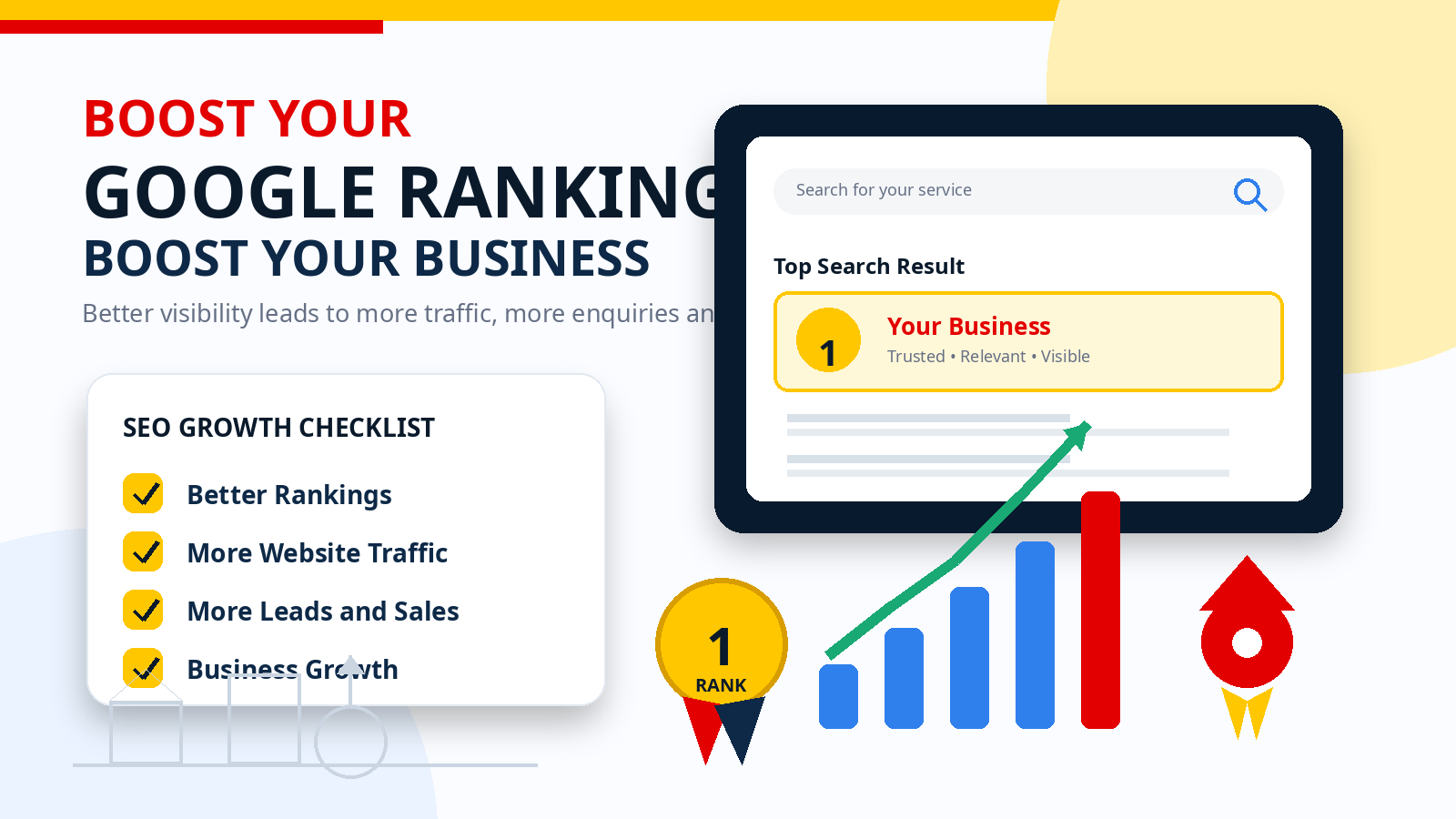
- Identify the search intent behind every target keyword
- Create one strong page for each important topic
- Write clear and compelling page titles
- Use descriptive headings throughout the content
- Add the main keyword naturally in relevant sections
- Improve introductions so visitors quickly understand the page
- Add useful internal links between related pages
- Optimize images and include descriptive alternative text
- Improve website speed and mobile usability
- Fix broken links and indexing problems
- Use structured data where relevant
- Optimize your Google Business Profile
- Maintain consistent business information online
- Request genuine customer reviews
- Create topic clusters around core services
- Publish original insights and practical examples
- Earn relevant and trustworthy backlinks
- Update important content regularly
- Track traffic, rankings, clicks, and conversions
- Use performance data to guide future improvements
Frequently Asked Questions About Improving Google Rankings
How can I improve my Google rankings?
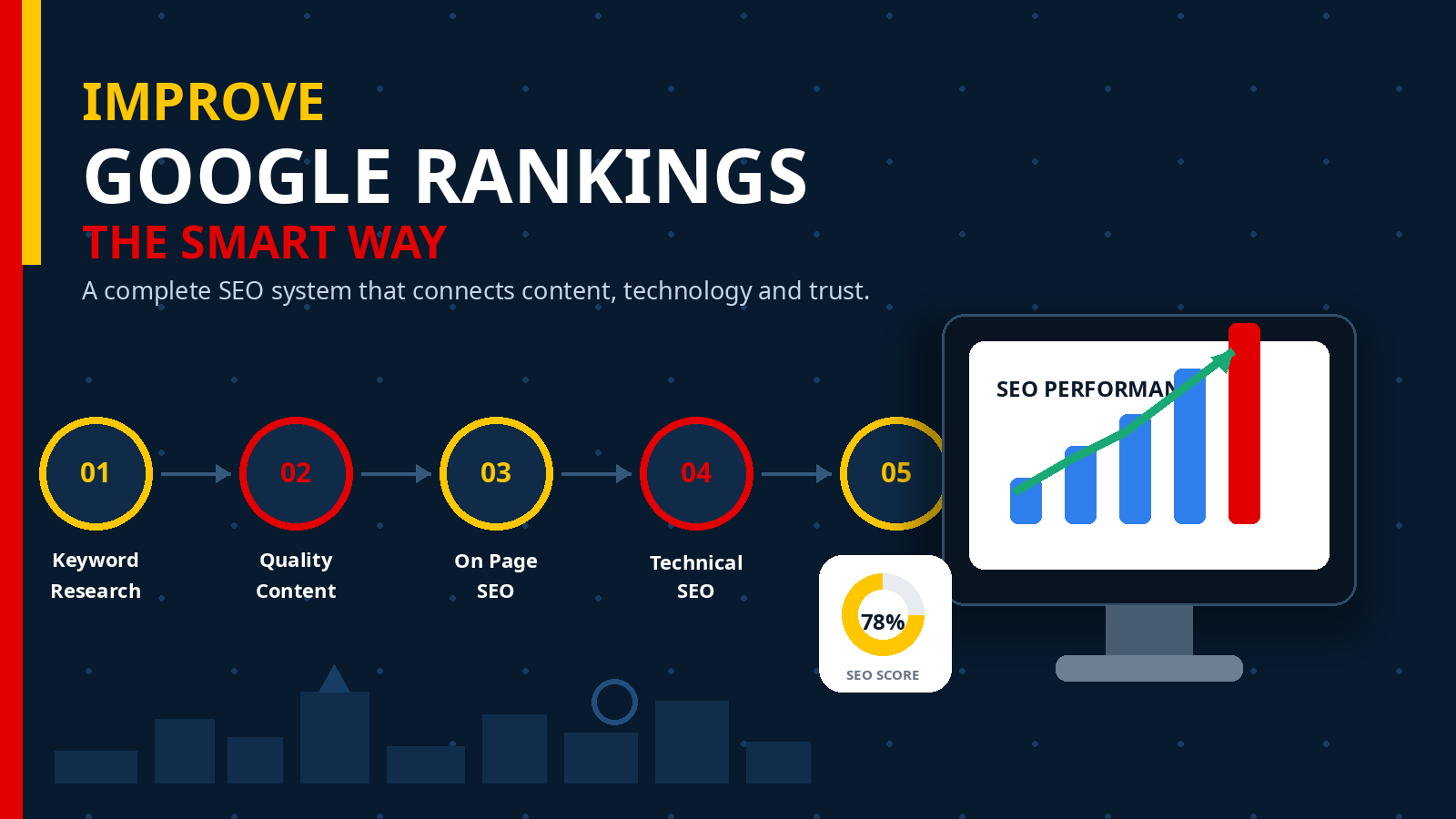
You can improve Google rankings by matching search intent, publishing useful content, improving technical SEO, strengthening internal links, optimizing page experience, building topical authority, earning relevant backlinks, and updating content regularly.
How long does it take to improve Google rankings?
The time required depends on competition, website authority, technical condition, content quality, backlink profile, and keyword difficulty. Some improvements may appear within weeks, while competitive keywords may require several months of consistent work.
Does publishing more content improve rankings?
Publishing more content can help when each page serves a clear purpose and provides genuine value. Publishing large amounts of thin, duplicated, or unfocused content is unlikely to produce sustainable results.
Are backlinks still important for Google rankings?
Relevant backlinks from trustworthy websites can strengthen authority and improve visibility. Quality, relevance, and authenticity are more important than the total number of links.
How does local SEO improve Google rankings?
Local SEO helps businesses appear for location based searches by improving Google Business Profile information, customer reviews, local content, business citations, service area relevance, and website authority.
Should I update old blog posts?
Yes. Updating older articles can improve accuracy, relevance, depth, search visibility, and user experience. Prioritize pages that have lost traffic or contain outdated information.
Can technical SEO alone improve rankings?
Technical SEO helps search engines access, understand, and index your website, but it works best when combined with useful content, strong page experience, relevant authority, and clear search intent.
Which SEO metrics should I track?
Track organic traffic, keyword visibility, search impressions, clicks, click rate, indexed pages, conversions, leads, revenue, local actions, and engagement on important landing pages.
Improve Your Google Rankings With a Complete SEO Strategy
Improving Google rankings requires more than inserting keywords into a website. Sustainable results come from combining valuable content, technical performance, page experience, local relevance, topical authority, trustworthy backlinks, and continuous measurement.
Businesses that consistently improve their websites are more likely to earn stronger visibility, attract qualified visitors, and convert search traffic into real enquiries and customers.
Digital Natives helps businesses develop practical SEO strategies focused on organic visibility, local search performance, website quality, content growth, and measurable results.
Whether you need help improving an existing website, optimizing your Google Business Profile, creating SEO content, or developing a complete digital marketing strategy, our team can help you build a stronger search presence.
Ready to improve your Google rankings?
Contact Digital Natives in LB Nagar, Hyderabad, and start building a search strategy designed for sustainable business growth.
Conclusion
There is no single shortcut that guarantees higher Google rankings. Search visibility improves when your website consistently provides the best possible answer, works smoothly across devices, demonstrates genuine expertise, and earns trust from users and other websites.
Start by fixing technical problems, improving important pages, strengthening internal links, creating useful topic clusters, optimizing local signals, and measuring the actions that matter to your business.
SEO is an ongoing process. Websites that continue learning, updating, and improving are better positioned to achieve lasting growth in Google search results.