Digital Marketing ROI: How to Measure Real Business Growth in 2026
Your Instagram campaign received thousands of views. Your website attracted more visitors. Your Google Ads campaign generated several enquiries.
But how much business did those activities actually generate?
This is one of the most important questions for companies investing in digital marketing.
Many businesses track impressions, likes, clicks and followers without understanding whether their marketing investment is producing profitable customers.
Digital Marketing ROI helps connect marketing expenditure with financial outcomes.
For businesses in Hyderabad, including LB Nagar, Dilsukhnagar, Gachibowli, Madhapur, Kukatpally and Hitech City, measuring marketing performance can help identify which channels deserve more investment and which activities need improvement.
This guide explains how to calculate digital marketing ROI, measure lead quality, understand customer acquisition costs and create a practical reporting system in 2026.

What Is Digital Marketing ROI?
Digital marketing return on investment measures the financial return generated from a marketing investment relative to its cost.
It helps businesses evaluate whether their marketing activities are financially worthwhile.
For example, a company may spend money on search advertising, social media campaigns, content creation and marketing software.
The important question is whether the resulting customer revenue and contribution justify those expenses.
Quick answer: Digital marketing ROI measures the return earned from marketing expenditure. A basic formula is ROI = ((Return attributable to marketing − Marketing cost) ÷ Marketing cost) × 100. For a more meaningful business calculation, use the contribution generated by acquired customers after relevant delivery costs rather than revenue alone.
ROI is different from reach, engagement and website traffic.
These metrics can help explain campaign performance, but they do not independently establish profitability.
Why Does Digital Marketing ROI Matter?
Marketing budgets are limited, especially for small businesses.
Without proper measurement, companies may continue investing in campaigns that generate attention but few suitable customers.
Measuring returns helps businesses:
- Understand marketing profitability
- Compare channel performance
- Identify inefficient spending
- Improve customer acquisition
- Evaluate lead quality
- Plan future budgets
- Make better commercial decisions
However, ROI should not be interpreted in isolation.
Some campaigns build awareness or influence customers who purchase much later.
A useful measurement system considers both immediate results and longer customer journeys.
How to Calculate Digital Marketing ROI
Consider a hypothetical Hyderabad business investing in a marketing campaign.
The following figures are illustrative, not actual Digital Natives client results.
| Metric | Example Amount |
|---|---|
| Total marketing investment | ₹50,000 |
| Revenue attributable to marketing | ₹2,00,000 |
| Direct delivery costs | ₹1,00,000 |
| Contribution before marketing costs | ₹1,00,000 |
| Contribution after marketing costs | ₹50,000 |
ROI formula
ROI = ((Contribution before marketing costs − Marketing investment) ÷ Marketing investment) × 100
Using the example:
ROI = ((₹1,00,000 − ₹50,000) ÷ ₹50,000) × 100 = 100%
In this simplified scenario, the business generates ₹1 in additional contribution after marketing costs for every ₹1 invested in marketing.
This calculation assumes the revenue is correctly attributed and that relevant direct costs are included.
For an accurate business assessment, also consider overhead allocation, refunds, repeat purchases, attribution uncertainty and the reporting period.
ROI versus ROAS
Return on ad spend, or ROAS, measures attributed revenue relative to advertising expenditure.
For example, ₹2,00,000 in attributed revenue divided by ₹50,000 in ad spend produces a ROAS of 4.
That does not mean the business achieved a 300% profit.
ROAS does not automatically account for product costs, service delivery, staff expenses or other business costs.
Important Digital Marketing Metrics to Track
Marketing performance becomes clearer when businesses track metrics across the customer journey.
Reach and discovery
These metrics indicate whether potential customers are encountering the brand.
- Impressions
- Reach
- Relevant search visibility
- Website sessions
Engagement
These metrics help evaluate whether people interact with marketing content.
- Engaged sessions
- Content interactions
- Landing page engagement
- Relevant enquiries initiated
Lead generation
These metrics connect marketing activity with potential customer interest.
- Form submissions
- Qualified calls
- Consultation requests
- Booking enquiries
- Sales accepted leads
Commercial outcomes
These metrics help assess financial performance.
- Customers acquired
- Revenue attributable to marketing
- Customer acquisition cost
- Gross contribution
- Customer lifetime value
- Marketing ROI
No single metric explains the complete performance of a campaign.
How to Measure Qualified Leads Instead of Just Enquiries
Not every enquiry is a suitable business opportunity.
A campaign may produce many messages from people who are outside the service area, have unrelated requirements or are not ready to purchase.
Businesses should distinguish between total enquiries and qualified leads.
Example lead qualification criteria
- The customer needs a relevant service.
- The customer is within the service area.
- The enquiry includes sufficient information.
- The budget is reasonably aligned with the service.
- The customer has a genuine purchase requirement.
The appropriate criteria depend on the business.
A salon may prioritize appointment bookings, while a website development agency may evaluate project requirements and budget.
Calculate cost per qualified lead
Cost per qualified lead = Marketing expenditure ÷ Number of qualified leads
Suppose a campaign costs ₹30,000 and produces 20 qualified leads.
The cost per qualified lead is ₹1,500.
This is an illustrative example.
The next question is how many of those leads become paying customers.
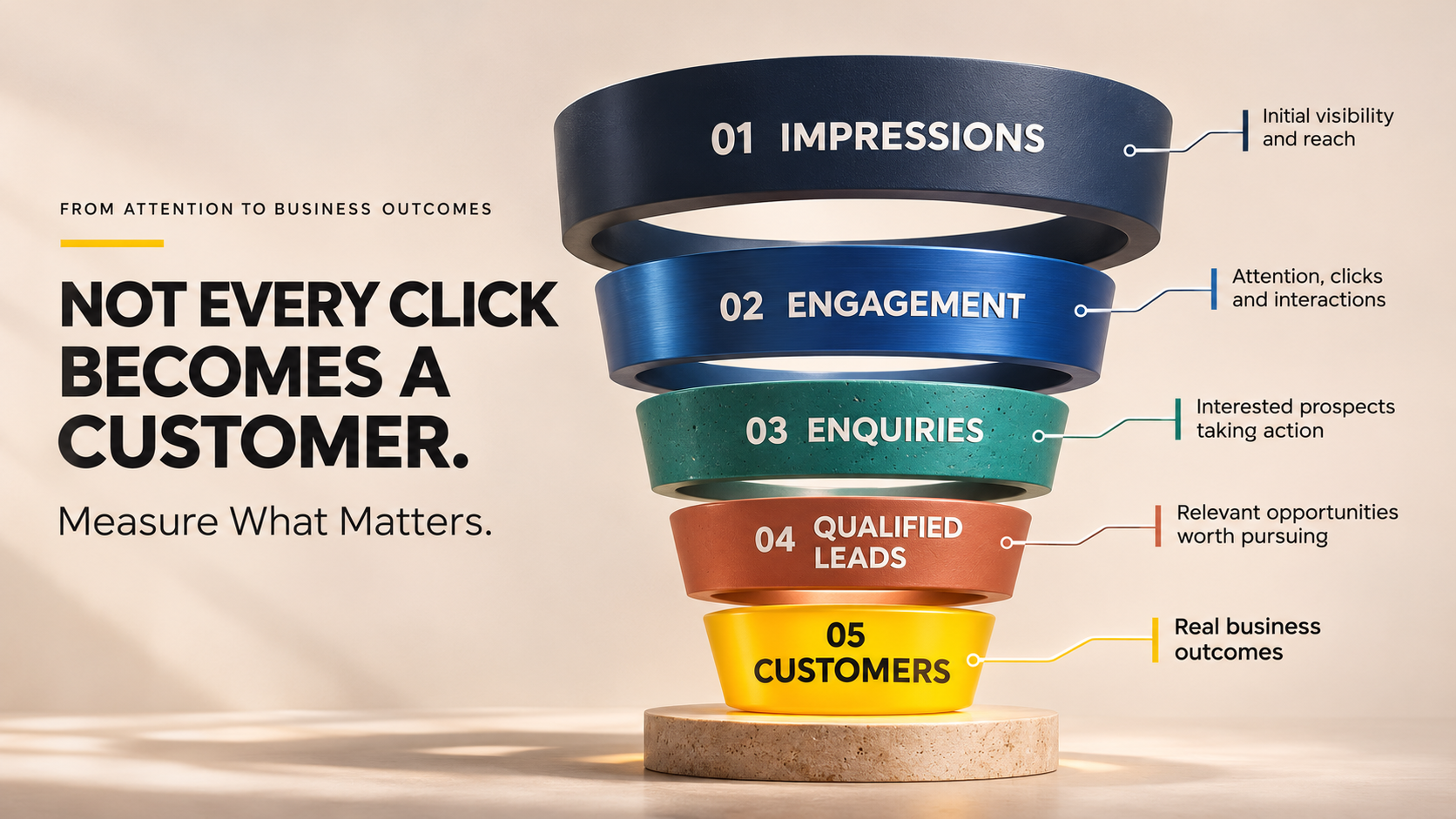
Understanding Customer Acquisition Cost
Customer Acquisition Cost, commonly called CAC, measures how much a business spends to acquire a new customer.
A simple marketing CAC formula is:
Marketing CAC = Total acquisition marketing costs ÷ New customers acquired
For example, if acquisition marketing costs ₹60,000 and generates 12 new customers, the marketing CAC is ₹5,000.
For a broader fully loaded CAC calculation, businesses may also include attributable sales salaries, software and other acquisition expenses.
Define the cost basis consistently before comparing periods.
A low CAC is not automatically desirable if customers generate little contribution.
A higher CAC may be commercially reasonable when customers have strong margins and long term value.
How to Measure ROI Across Digital Marketing Channels
Different channels influence customers at different stages of their buying journey.
Search engine optimization
SEO may attract customers searching for services or information.
Measure relevant organic traffic, enquiries, customers acquired and the ongoing costs of content and optimization.
Google Ads
Paid search campaigns can be measured through advertising costs, relevant clicks, qualified leads and customer outcomes.
Review actual sales and contribution rather than focusing only on click volume.
Social media marketing
Social content may support discovery, engagement, enquiries and brand recognition.
Track relevant website visits, attributable enquiries, bookings and sales where measurement is possible.
Email marketing
Email campaigns can support customer education, follow up and repeat purchases.
Measure meaningful actions, customer retention and incremental revenue rather than relying exclusively on open rates.
Google Business Profile
For eligible local businesses, profile interactions may include calls, website clicks and direction requests.
Connect these interactions to actual enquiries where possible.
A profile view alone is not proof of customer acquisition.
Using Google Analytics 4 for Marketing Measurement
Google Analytics 4, commonly called GA4, helps businesses understand website and app interactions.
It uses an event based measurement model.
Events can record actions such as form submissions, purchases and other important interactions.
Understand key events
In GA4, a key event is an event identified as particularly important to the business.
For a service business, a successfully submitted enquiry form may be configured as a key event.
For ecommerce, a completed purchase may be an important key event.
Google also documents recommended events for lead generation, including:
generate_leadfor an initial leadqualify_leadwhen a lead is qualifiedworking_leadwhen the lead is being workedclose_convert_leadwhen the lead becomes a customer
These events require appropriate implementation and business processes. They are not all automatically collected.
Read the official GA4 recommended events documentation and key events guidance.
Validate your tracking
Before relying on reports, test whether the relevant events fire correctly.
Check for duplicate events, missing form submissions, incorrect campaign tagging and inconsistent customer records.
Analytics reports are only as reliable as the underlying implementation.
Understanding Marketing Attribution
Customers rarely follow one identical path to purchase.
Someone may discover a brand through Instagram, visit its website through Google Search and later return directly to submit an enquiry.
Marketing attribution attempts to assign credit to the interactions that contributed to a business outcome.
Why attribution is complicated
- Customers use multiple devices.
- Some interactions happen offline.
- Tracking consent can limit available information.
- Customers may return through different channels.
- Advertising platforms may use different attribution methods.
As a result, attribution reports are estimates based on available data and measurement rules.
Avoid treating every platform’s claimed conversions as entirely separate sales.
Compare marketing reports with actual CRM, booking and sales records.
Why Customer Lifetime Value Matters
Some customers purchase once. Others return repeatedly.
Customer lifetime value, or CLV, estimates the value a customer generates throughout the relationship with a business.
For example, a salon may receive repeat appointments, while a website development agency may provide ongoing maintenance or marketing services.
Businesses should evaluate customer acquisition costs alongside expected contribution from future purchases.
However, projected lifetime value should be based on realistic retention and margin data.
Do not justify unlimited marketing expenditure using unsupported assumptions about future purchases.
How to Improve Digital Marketing ROI
Improving ROI does not always mean spending less.
It may involve reaching more suitable customers, improving conversion rates or increasing customer value.
1. Improve audience targeting
Focus campaigns on customers with relevant needs and genuine service eligibility.
2. Improve landing pages
Make the offer, service details, trust information and contact options easy to understand.
3. Review campaign messages
Use accurate claims and clear communication that match customer expectations.
4. Improve enquiry handling
Respond promptly and provide a reliable follow up process.
5. Review lead quality
Identify which campaigns generate suitable opportunities rather than simply the most messages.
6. Reduce measurement errors
Correct duplicate tracking, inaccurate campaign tags and missing sales information.
7. Test improvements carefully
Compare meaningful changes using appropriate data and avoid drawing conclusions from very small samples.
8. Review customer retention
Improve the customer experience and evaluate appropriate opportunities for repeat business.
Digital Marketing ROI for Hyderabad Businesses
Different businesses require different performance indicators.
Salons and local service businesses
Businesses in LB Nagar and Dilsukhnagar may track appointment bookings, completed services, repeat customers and marketing acquisition costs.
Professional service companies
Companies in Gachibowli and Hitech City may prioritize qualified consultations, proposals, signed projects and contribution per customer.
Retail businesses
Businesses in Kukatpally may review ecommerce purchases, store enquiries, order values and repeat purchasing behavior.
Digital service providers
Agencies in Madhapur and other commercial areas may measure qualified project leads, proposal conversion rates, customer acquisition costs and recurring service revenue.
These are examples of useful measurements, not assumptions about the performance of individual Hyderabad businesses.
A Practical 30 Day Marketing Measurement Plan
Week 1: Define Business Outcomes
Identify the customer actions that matter most.
Document marketing expenses, lead qualification criteria and the relevant sales process.
Week 2: Review Tracking
Check GA4 events, campaign tagging, website forms and available CRM records.
Test important interactions before relying on the data.
Week 3: Connect Leads With Customers
Review which enquiries became qualified leads, proposals and paying customers.
Identify missing information and duplicate records.
Week 4: Build a Reporting Dashboard
Compare marketing costs, qualified leads, acquired customers, attributable contribution and ROI.
Identify one or two practical improvements for the following month.
The purpose of this schedule is to establish better measurement, not to promise a particular return within 30 days.

Common Digital Marketing ROI Mistakes
- Confusing impressions with customers
- Counting every enquiry as a qualified lead
- Comparing channels using inconsistent attribution
- Ignoring service delivery costs
- Confusing ROAS with profit
- Overlooking recurring marketing expenses
- Failing to track completed sales
- Counting duplicate conversions
- Using inaccurate customer lifetime value estimates
- Ignoring offline sales
- Making decisions from insufficient data
- Expecting every campaign to produce immediate revenue
Digital Marketing ROI Checklist
- Define measurable business goals
- Document marketing expenditure
- Identify important customer actions
- Configure relevant analytics events
- Test conversion tracking
- Use consistent campaign tagging
- Define qualified lead criteria
- Connect leads with sales records
- Calculate cost per qualified lead
- Calculate customer acquisition cost
- Review attributable revenue
- Include relevant delivery costs
- Distinguish ROI from ROAS
- Consider customer retention
- Review attribution limitations
- Compare reporting periods consistently
- Document measurement assumptions
- Prioritize improvements based on evidence
Conclusion: Measure Business Growth, Not Just Marketing Activity
Digital Marketing ROI helps businesses understand whether their marketing investment is producing meaningful financial results.
Website visits, social media engagement and advertising clicks can provide useful information, but they should be connected to qualified enquiries, customers and business contribution wherever possible.
For businesses across Hyderabad and Telangana, effective measurement begins with clear objectives, accurate tracking and consistent sales information.
There is no universal marketing channel that guarantees the highest return for every business.
The best approach is to understand your customers, measure what matters and improve campaigns using reliable evidence.
Frequently Asked Questions
What is digital marketing ROI?
Digital marketing ROI measures the financial return generated from marketing investment relative to its cost. It helps businesses assess whether marketing activities produce worthwhile commercial outcomes.
How do you calculate digital marketing ROI?
A basic formula is ROI = ((Return attributable to marketing minus marketing cost) divided by marketing cost) multiplied by 100. For meaningful financial analysis, use contribution after relevant delivery costs rather than revenue alone.
What is the difference between ROI and ROAS?
ROAS compares advertising revenue with advertising spend. ROI evaluates financial return relative to investment and should account for relevant costs. A high ROAS does not necessarily mean a campaign is profitable.
What is customer acquisition cost?
Customer acquisition cost measures the cost of acquiring a new customer. Businesses should define whether their calculation includes only marketing expenditure or broader acquisition expenses such as attributable sales costs.
Can Google Analytics 4 measure leads?
Yes. GA4 supports events and key events for important customer actions. Google also provides recommended lead generation events. These must be implemented and validated appropriately.
Which digital marketing channel has the highest ROI?
There is no universally highest performing channel. Results depend on customer demand, competition, business margins, campaign execution and measurement methods.
How can Digital Natives help businesses measure marketing performance?
Digital Natives provides digital marketing, SEO and website development services in Hyderabad. Businesses can contact the team to discuss marketing objectives, campaign planning and performance measurement requirements.
Your Marketing Should Deliver More Than Numbers on a Dashboard
Understand which campaigns attract relevant customers, which enquiries become sales and where your marketing investment creates value.
Digital Natives helps businesses across Hyderabad and Telangana plan and improve digital marketing strategies.
Location: LB Nagar, Hyderabad
Phone: +91 9052666707
Email: info@digitalnatives.co.in